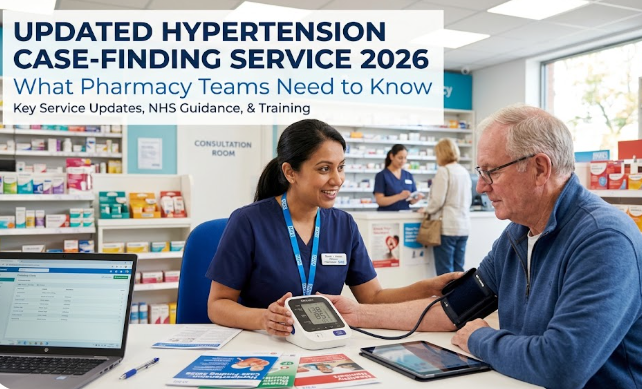
Community pharmacies are being asked to do more clinical work than ever, and the latest update to the Hypertension Case-Finding Service is another reminder that the detail matters. NHS England has published a revised service specification, and the changes come into effect on Thursday 3 September 2026, giving pharmacy teams a relatively short window to get ready.
For many pharmacies, this will not mean a complete reset. But it will mean checking processes, updating SOPs, refreshing training, and making sure the whole team understands how the service should now work in practice. If your pharmacy already provides blood pressure checks, this is one of those updates that is easy to overlook but important to act on.
What has changed
The updated Hypertension Case-Finding Service specification was published in August 2026 and agreed as part of the 2025/26 CPCF negotiations. Community Pharmacy England says the changes are the second major update to the service, following earlier changes in December 2023. The new version covers both the clinic blood pressure check element and ABPM, along with updated requirements for records, governance, promotion, referrals, and service delivery.
One of the key things to note is that community pharmacies offering the service must continue to provide both stages where clinically required. That means it is not a “clinic checks only” service; if ABPM is needed, the pharmacy must be set up to deliver it properly.
Why this matters now
This update matters because blood pressure case-finding remains one of the most practical ways community pharmacy can support earlier diagnosis and cardiovascular prevention. Community Pharmacy England states that hypertension is a major risk factor for cardiovascular disease, and that millions of people in England may still have undiagnosed high blood pressure. That gives the service clear public health value, but it also means the standards around delivery need to stay tight.
For pharmacy owners, the practical question is simple: can your team deliver this service smoothly, safely and consistently under the new specification? If the answer is not a confident yes, then this update is a prompt to fix the gaps now rather than later.
Key service points
The service still begins with a clinic blood pressure check for eligible patients, generally adults aged 40 and over without a prior diagnosis of hypertension who have not had their blood pressure checked in the last five years. Where clinically indicated, the second stage is ABPM, with results shared with the patient’s GP practice to support diagnosis and management.
Community Pharmacy England also notes that the service can be signposted by general practice, optometry, and dental colleagues in some cases, which makes local relationships more important than ever. Pharmacies should also remember that the service has specific requirements regarding consultation rooms, equipment, IT systems, record-keeping, and staff training.
What pharmacies should check
The most useful thing a pharmacy can do right now is carry out a quick internal review. Start with the SOP and make sure it reflects the 2026 update, not just the old version. Then check that staff know the correct patient eligibility criteria, the workflow for clinic checks, what to do when ABPM is needed, and how results are shared with the GP practice.
It is also worth checking the practical side of delivery. The service requires a consultation room that meets the relevant standards, validated BP equipment, and an NHS-assured clinical IT system for records and claims. If any of those elements are outdated, missing, or only understood by one person in the business, the pharmacy is exposed to avoidable problems.
Training and team readiness
Community Pharmacy England is clear that staff involved in the service should be familiar with the relevant NICE guidance, the operational process in the specification, and the equipment training provided by the supplier. That means this should not be treated as “common sense” work. It needs proper briefing and documented competence.
The whole pharmacy team can also play a role in promoting the service and recruiting suitable patients. In practice, that means counter staff, support staff, dispensing team members, and pharmacists all need a simple explanation of who is eligible and how to offer the service confidently. A short team huddle is often enough to improve uptake significantly if it is repeated consistently.
Check Pharmacy Academy for related training courses.
Off-site provision and workflow
Another point worth noting is that off-site provision is possible in certain cases, but only with prior agreement and subject to specific limits and governance requirements. That may be useful for pharmacies that want to reach harder-to-access groups, but it should be treated as an operational project rather than a casual add-on.
For most pharmacies, the bigger issue will be workflow. If BP checks are being fitted around busy dispensing periods, the service can easily become inefficient or inconsistent. A good process means knowing when appointments are booked, where the patient waits, how the reading is recorded, how follow-up is handled, and who checks that the GP communication has gone through correctly.
The commercial angle
This update is not just a compliance issue; it is also a reminder that service design matters commercially. Blood pressure checks can be a good service for pharmacies that have the right team, the right room, and the right patient base. But the service only performs well if it is actively managed rather than left to chance.