For pharmacists trained outside the UK, demonstrating strong English language ability is a mandatory step before applying to practise. Clear communication is essential in pharmacy practice — whether counselling patients, collaborating with healthcare professionals, or ensuring safe dispensing.
The General Pharmaceutical Council (GPhC) requires applicants to provide evidence of English language proficiency as part of the pharmacist registration process. Most international pharmacists meet this requirement through recognised language tests such as IELTS or the Occupational English Test (OET).
Understanding these requirements early can help avoid delays during the registration process.
Why English Language Proficiency Is Required
Pharmacists in the UK must communicate accurately with patients, prescribers, and other healthcare professionals. Miscommunication can lead to medication errors or patient safety risks.
Because of this, the GPhC requires pharmacists to demonstrate the ability to:
- Communicate clearly with patients about medicines and health conditions
- Understand prescriptions and clinical information
- Collaborate with doctors, nurses, and other healthcare professionals
- Maintain accurate records and documentation
English language competency is therefore assessed before registration.
IELTS Requirements for Pharmacists
The International English Language Testing System (IELTS) is the most commonly used test for pharmacists applying to register in the UK.
The GPhC currently requires applicants to achieve the following scores in the IELTS Academic test:
Minimum IELTS scores:
- Overall score: 7.0
- Reading: 7.0
- Listening: 7.0
- Speaking: 7.0
- Writing: 6.5
These scores must usually be achieved in a single sitting of the test.
IELTS results are typically valid for two years from the test date when submitting a registration application.
OET (Occupational English Test) Alternative
Some applicants choose the Occupational English Test (OET) instead of IELTS. OET is designed specifically for healthcare professionals and focuses on real-world medical communication scenarios.
For pharmacists, the GPhC requires:
Minimum OET scores:
- Reading: Grade B
- Listening: Grade B
- Speaking: Grade B
- Writing: Grade C+
Many candidates prefer OET because the test uses pharmacy and healthcare contexts, such as patient consultations or professional documentation.
Who Needs to Take an English Test?
English language testing is generally required for pharmacists who:
- Qualified outside the UK
- Are applying through the overseas pharmacist registration route
- Completed pharmacy education in a non-English speaking country
However, exemptions may apply if the applicant completed pharmacy education in certain countries where English was the primary language of instruction.
Applicants should always check the latest guidance before relying on exemptions.
Evidence Required by the GPhC
When applying for registration, applicants must submit official proof of their English language qualification.
This typically includes:
- Official IELTS or OET test results
- Test report number or verification code
- Evidence that the test was taken within the accepted timeframe
The GPhC may verify test results directly with the testing organisation.
Tips for Achieving the Required IELTS Score
Many pharmacists underestimate the writing and speaking components of IELTS. Preparation is important to reach the required score across all sections.
Helpful preparation strategies include:
1. Focus on healthcare communication
Practice explaining medicines, dosage instructions, and side effects in English.
2. Improve medical vocabulary
Understanding pharmacy terminology improves both the reading and listening sections.
3. Practise timed writing tasks
Many candidates lose marks due to poor time management in the writing section.
4. Take mock tests
Practice tests simulate exam conditions and help identify weaker areas.
Common Mistakes That Delay Applications
Several issues regularly slow down pharmacist registration applications:
- Submitting expired test results
- Not meeting minimum scores in each section
- Taking the wrong IELTS version (General instead of Academic)
- Failing to submit official documentation
Checking the requirements carefully before submitting an application can prevent delays.
Official Guidance and Regulatory Sources
The English language requirements are set by the General Pharmaceutical Council (GPhC) and may change over time. Applicants should always review the official guidance before preparing their application.
Useful resources include:
- GPhC guidance on English language requirements
https://www.pharmacyregulation.org - Overseas pharmacist registration guidance
https://www.pharmacyregulation.org/registering-pharmacist
These pages provide the most up-to-date information on accepted tests and minimum scores.
Where English Requirements Fit in the UK Pharmacist Pathway
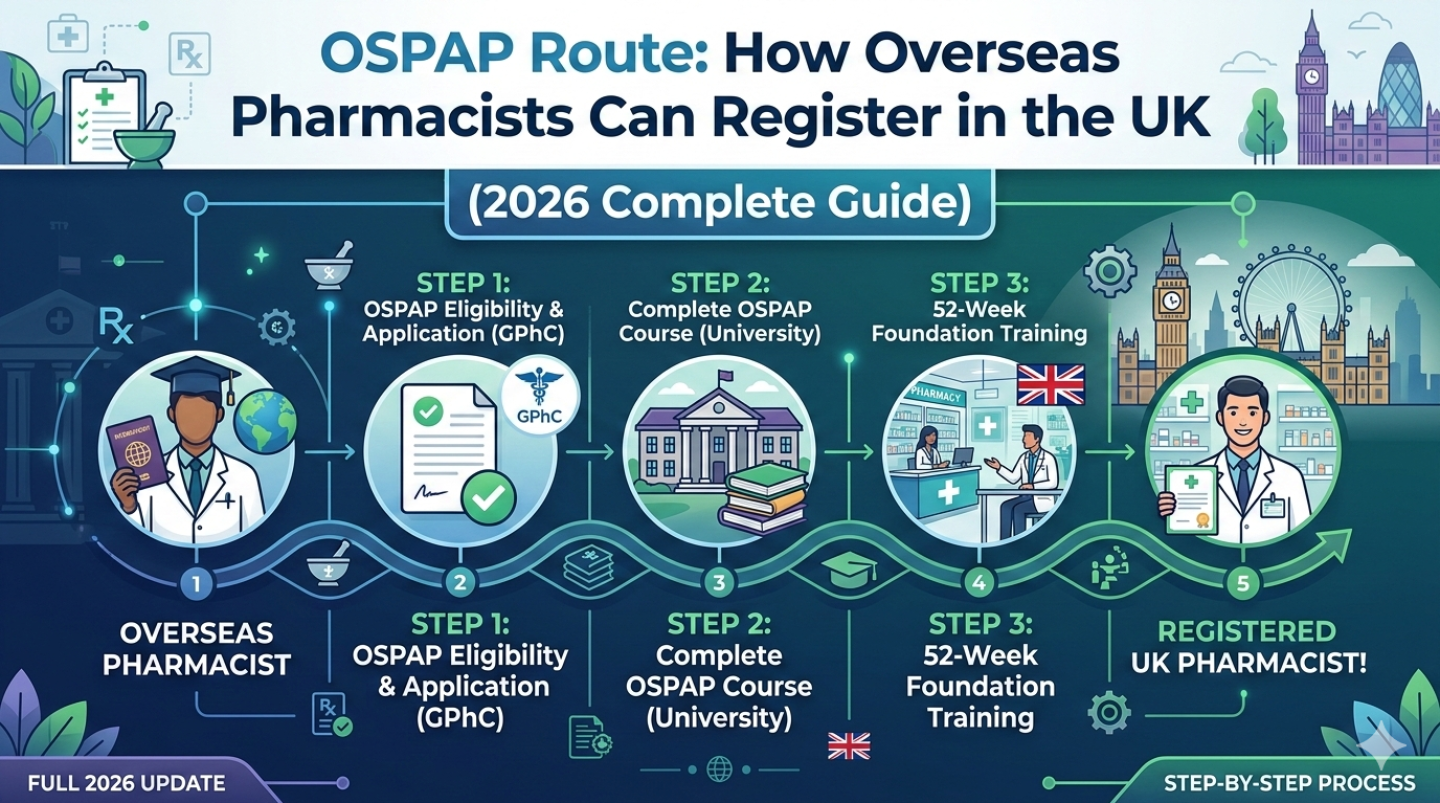
For most overseas pharmacists, English testing is one of the first steps before progressing to:
- GPhC eligibility assessment
- Overseas Pharmacist Assessment Programme (OSPAP)
- Foundation training year
- GPhC registration assessment
Preparing early for the IELTS or OET requirement helps keep the registration process moving smoothly.
FAQ
Pharmacists usually need an overall IELTS score of 7.0, with at least 7.0 in reading, listening and speaking, and 6.5 in writing when taking the IELTS Academic test.
Yes. The Occupational English Test (OET) is accepted by the GPhC for pharmacist registration if the required grades are achieved.
IELTS test results are generally valid for two years when submitting a registration application.
Some applicants from English-speaking education systems may be exempt, but the GPhC may still require evidence of language proficiency depending on the circumstances.