If you qualified as a pharmacist outside Great Britain and want to practise in England, Scotland or Wales, you may need to complete the Overseas Pharmacists Assessment Programme (OSPAP).
The OSPAP route is regulated by the General Pharmaceutical Council (GPhC), which sets the standards for pharmacist registration in Great Britain.
This guide explains eligibility, application steps, English language requirements, costs, and what happens after OSPAP.
What Is OSPAP?
OSPAP stands for Overseas Pharmacists Assessment Programme.
It is a one-year, full-time postgraduate diploma designed to ensure that pharmacists trained outside Great Britain meet UK standards of:
- Clinical practice
- Pharmaceutical law
- Ethics and professionalism
- Patient safety
OSPAP courses are delivered by GPhC-accredited UK universities.
Completion of OSPAP alone does not grant registration — further steps are required.
Who Needs to Complete OSPAP?
Whether you need OSPAP depends on:
- Where you obtained your pharmacy qualification
- Whether your qualification is recognised by the GPhC
Most pharmacists qualified outside the UK (including non-EEA countries) must complete OSPAP before progressing to registration.
The only way to confirm eligibility is by applying directly to the General Pharmaceutical Council for an eligibility assessment.
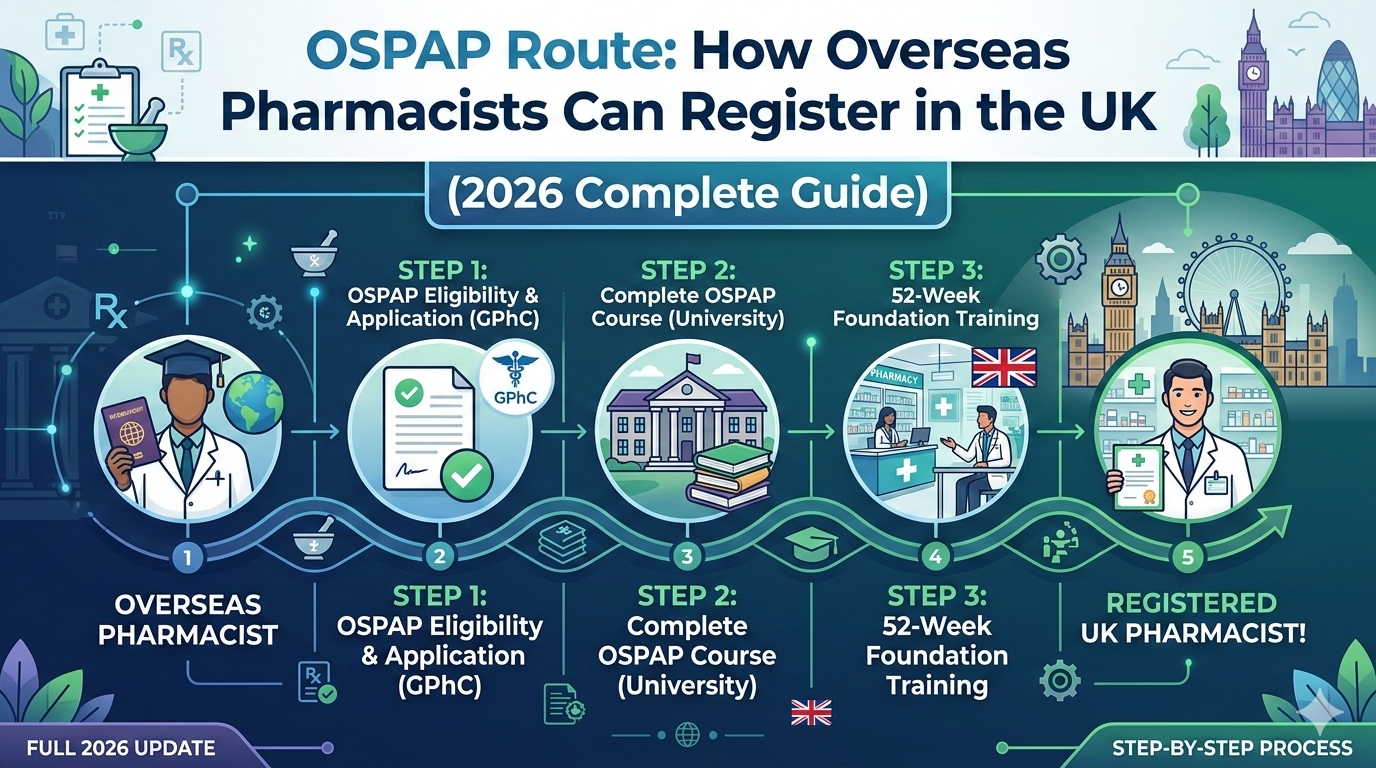
Step 1: Apply to the GPhC for Eligibility
Before applying to any university, you must:
- Submit qualification documents to the GPhC
- Provide academic transcripts
- Provide evidence of pharmacist registration (if applicable)
- Demonstrate English language competence
- Pay the evaluation fee
The GPhC will assess whether your qualification is comparable to UK standards.
If approved, you will receive confirmation that you are eligible to apply for OSPAP.
English Language Requirements (2026 Standards)
Most applicants must demonstrate English proficiency.
Accepted tests typically include:
IELTS Academic
- Minimum overall score: 7.0
- Minimum 7.0 in each component
OET (Pharmacy)
- Minimum Grade B in all components
The General Pharmaceutical Council sets strict English standards because pharmacists must communicate clearly and safely with patients.
Some applicants may be exempt if they completed their pharmacy degree in a recognised majority English-speaking country.
Always verify current criteria directly with the GPhC.
Step 2: Apply to an Accredited OSPAP University
Once deemed eligible, you may apply to GPhC-accredited OSPAP providers.
OSPAP is:
- 1 year full-time
- Postgraduate diploma level
- Intensive and clinically focused
Typical tuition fees:
- £12,000 – £20,000+ (international rates may be higher)
Places are competitive and limited each year.
What Does OSPAP Cover?
The programme focuses on:
- UK pharmacy law
- Clinical therapeutics
- Professional ethics
- NHS systems
- Patient consultation skills
- Prescribing science
The aim is to align overseas training with UK clinical and regulatory expectations.
Step 3: Foundation Training Year
After successfully completing OSPAP, you must:
- Complete 12 months of foundation training in an approved pharmacy setting
This training is competency-based and supervised.
Standards are regulated by the General Pharmaceutical Council.
You must demonstrate competence across clinical, legal, and professional domains.
Step 4: Pass the GPhC Registration Assessment
At the end of foundation training, candidates must pass the national registration assessment.
The assessment tests:
- Clinical knowledge
- Pharmaceutical calculations
- Safe decision-making
- Legal application
Only candidates who pass may apply for registration.
Step 5: Apply for Registration
After:
- Completing OSPAP
- Completing foundation training
- Passing the registration assessment
You may apply to join the professional register maintained by the General Pharmaceutical Council.
Once registered, you can legally practise in:
- England
- Scotland
- Wales
(Northern Ireland has a separate regulator.)
How Long Does the OSPAP Route Take?
Typical timeline:
- GPhC eligibility assessment: Several months
- OSPAP programme: 1 year
- Foundation training: 1 year
- Registration assessment: Scheduled nationally
Total: Approximately 2–3 years from eligibility approval to registration.
Visa Considerations
Most international applicants require:
- A Student visa for OSPAP
- A Skilled Worker visa for employment after registration
Visa rules are governed by UK immigration law and may change.
Applicants should consult official UK Government guidance.
Total Estimated Costs
| Stage | Approximate Cost |
|---|---|
| GPhC evaluation fee | Several hundred pounds |
| OSPAP tuition | £12k – £20k+ |
| Living costs (1 year) | £10k – £18k+ |
| Foundation training | Paid employment (varies) |
| Registration assessment fee | Additional fee applies |
Careful financial planning is essential.
Common Reasons Applications Are Delayed
- Incomplete documentation
- Insufficient English language scores
- Academic qualification gaps
- Delays in visa processing
Starting the process early is strongly advised.
Is the OSPAP Route Worth It?
The UK pharmacy profession offers:
- Stable employment
- Competitive salaries
- Advanced clinical roles
- Independent prescribing opportunities
However, the route requires:
- Financial investment
- Academic commitment
- Regulatory patience
Applicants should carefully assess readiness before starting the process.
Frequently Asked Questions
No — unless the GPhC determines your qualification is directly recognised.
No. It is an in-person, full-time programme due to clinical requirements.
Yes, foundation trainees are typically paid employees.
No. You must complete foundation training and pass the registration assessment first.
The OSPAP route provides a structured pathway for overseas pharmacists to meet UK standards and practise safely within the NHS and private healthcare systems.
The key first step is always to apply to the General Pharmaceutical Council for an eligibility assessment before committing to any university.
With proper preparation, financial planning, and persistence, overseas pharmacists can successfully transition into UK practice.