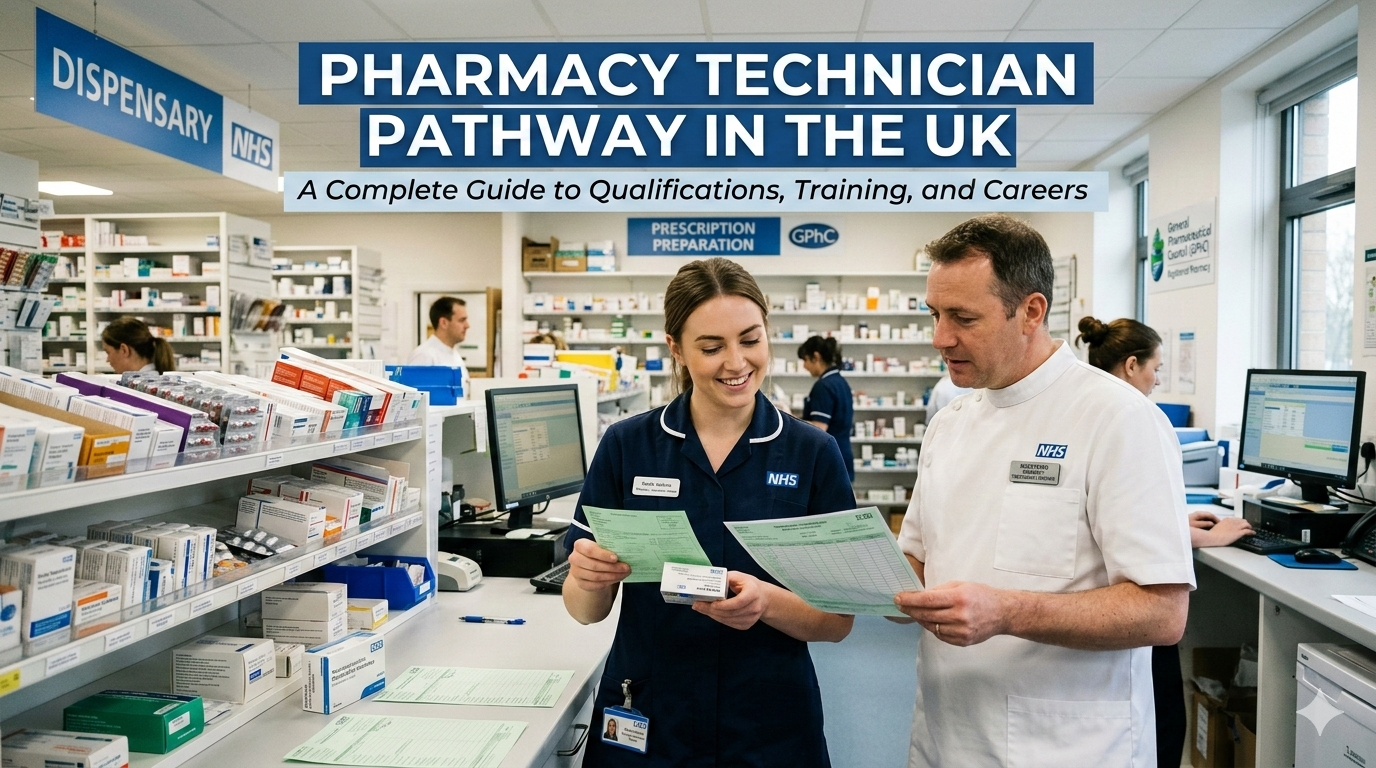
Training, Qualifications and Registration Explained
Pharmacy technicians play an essential role in the safe preparation and supply of medicines. Working alongside pharmacists and other healthcare professionals, they help ensure patients receive the correct medicines, accurate advice, and efficient service.
If you are interested in working in pharmacy but prefer a more practical and technical role, becoming a pharmacy technician can be an excellent career path. In the UK, pharmacy technicians must complete recognised training and register with the General Pharmaceutical Council before practising.
What Does a Pharmacy Technician Do?
Pharmacy technicians support the day-to-day running of pharmacies in a wide range of settings, including community pharmacies, hospitals, GP practices, and pharmaceutical services.
Typical responsibilities include:
- Preparing and dispensing medicines
- Managing prescriptions and medication records
- Supporting pharmacists with clinical services
- Ordering and managing stock
- Ensuring medicines are stored correctly
- Assisting with controlled drug procedures
- Providing advice on over-the-counter medicines where appropriate
In many pharmacies, technicians are heavily involved in accuracy checking, medicines management, and workflow coordination, which helps pharmacists focus on clinical decision-making and patient care.
The Qualifications Required
To register as a pharmacy technician in the UK, you must complete an approved training programme recognised by the General Pharmaceutical Council.
The most common pathway includes two key qualifications:
Level 3 Diploma in the Principles and Practice for Pharmacy Technicians
and
Level 3 Diploma in Pharmacy Service Skills
These qualifications combine classroom learning with practical training in a pharmacy workplace.
Training usually takes around two years to complete and must be undertaken while working in a pharmacy environment under appropriate supervision.
Entry Requirements
Entry requirements can vary depending on the employer and training provider, but many programmes expect:
- GCSEs in English, Maths, and Science
- Strong attention to detail
- Good communication skills
- An interest in healthcare and medicines
Some employers recruit trainee pharmacy technicians directly and support them through the full qualification programme.
Others may prefer candidates who already have experience working as a pharmacy assistant or dispensing assistant.
Workplace Training
Pharmacy technician training is largely work-based, meaning trainees gain practical experience while studying.
During training, trainees typically learn how to:
- Process prescriptions accurately
- Understand different medicine formulations
- Manage pharmaceutical stock
- Maintain pharmacy records
- Follow legal and regulatory procedures
- Work safely within Standard Operating Procedures (SOPs)
Because medicines safety is critical, trainees are gradually given greater responsibility as their knowledge and confidence grow.
Registration With the GPhC
After successfully completing the required qualifications and workplace training, candidates can apply to join the register of pharmacy technicians maintained by the General Pharmaceutical Council.
Registration confirms that the technician has met the professional standards required to practise safely.
Registered pharmacy technicians must also:
- Follow professional standards
- Maintain continuing professional development (CPD)
- Renew their registration each year
This ensures pharmacy technicians remain up to date with developments in medicines and pharmacy practice.
Where Pharmacy Technicians Work
Once qualified, pharmacy technicians can work in several healthcare environments.
Common settings include:
Community pharmacies
Supporting dispensing, patient services, and stock control.
Hospital pharmacies
Preparing medicines, managing ward stock, and supporting clinical pharmacy teams.
Primary care and GP practices
Helping with medicines optimisation and prescription management.
Specialist pharmacy services
Including procurement, medicines information, and regulatory compliance roles.
Some experienced technicians move into accuracy checking roles, supervisory positions, or training roles within pharmacy organisations.
Career Progression
Pharmacy technicians have several opportunities for professional development.
With experience and additional training, technicians may progress into roles such as:
- Accuracy Checking Pharmacy Technician (ACPT)
- Medicines management technician
- Pharmacy team leader or supervisor
- Specialist hospital technician roles
- Pharmacy education or training support
The role has expanded significantly in recent years, particularly within hospital and primary care settings where technicians are increasingly involved in medicines optimisation programmes.
Is This the Right Pharmacy Career for You?
For people interested in healthcare, science, and patient safety, pharmacy technician training provides a practical and rewarding route into the profession.
The pathway offers:
- Structured training
- Strong job demand across healthcare settings
- Opportunities for career progression
- A vital role in the safe supply of medicines
Many pharmacy technicians find the role particularly rewarding because it combines technical accuracy, teamwork, and patient-focused healthcare.


