Education · Registration · Compliance Pharmacy Academy →
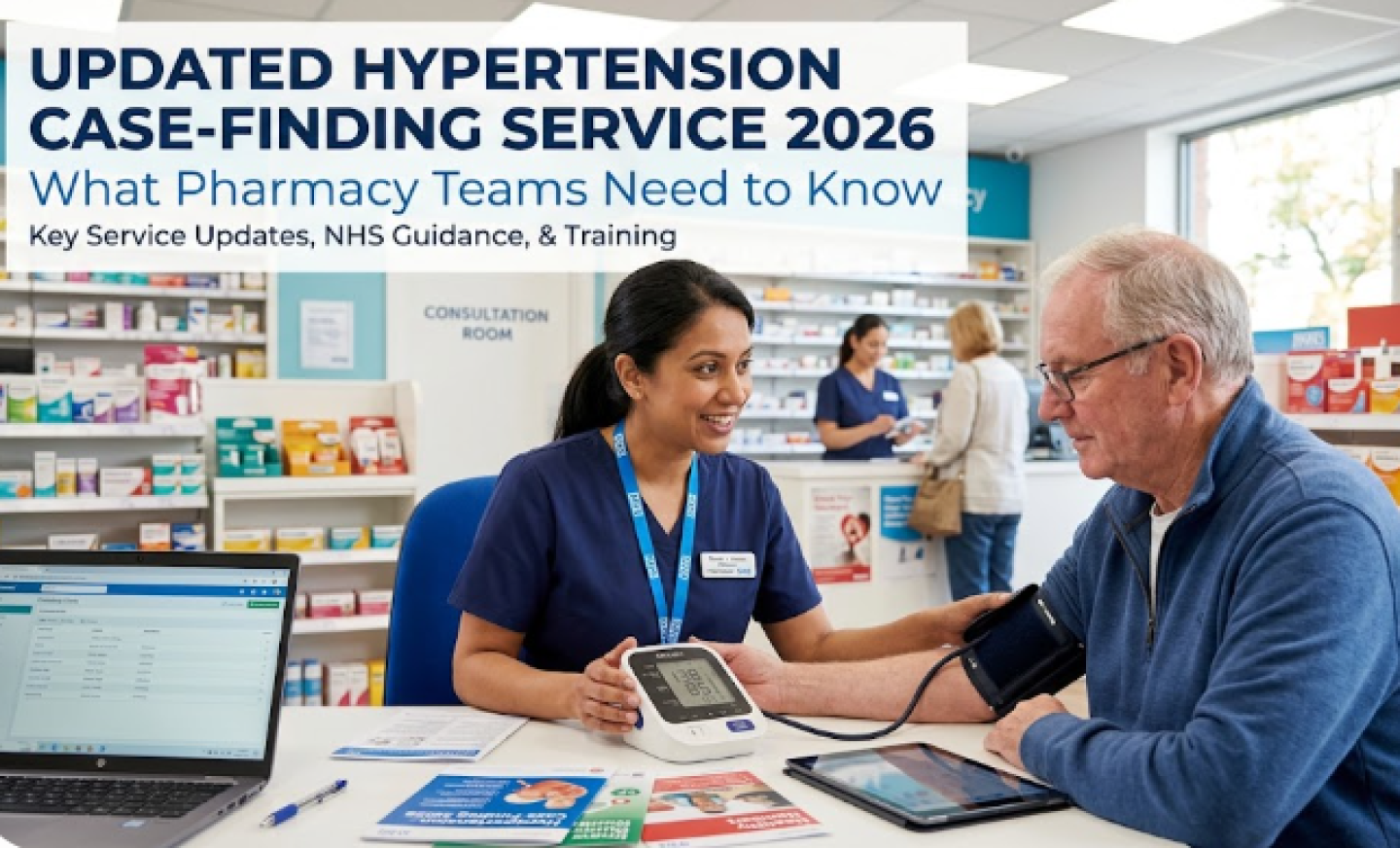
Updated Hypertension Case-Finding Service 2026

Updated Hypertension Case-Finding Service 2026: What Pharmacy Teams Need to Know

Community pharmacies are being asked to do more clinical work than ever, and the latest update to the Hypertension Case-Finding Service is another reminder that the detail matters. NHS England has published a revised service specification, and the changes come into effect on Thursday 3 September 2026, giving pharmacy teams a relatively short window to get ready.

For many pharmacies, this will not mean a complete reset. But it will mean checking processes, updating SOPs, refreshing training, and making sure the whole team understands how the service should now work in practice. If your pharmacy already provides blood pressure checks, this is one of those updates that is easy to overlook but important to act on.

What has changed

The updated Hypertension Case-Finding Service specification was published in August 2026 and agreed as part of the 2025/26 CPCF negotiations. Community Pharmacy England says the changes are the second major update to the service, following earlier changes in December 2023. The new version covers both the clinic blood pressure check element and ABPM, along with updated requirements for records, governance, promotion, referrals, and service delivery.

One of the key things to note is that community pharmacies offering the service must continue to provide both stages where clinically required. That means it is not a “clinic checks only” service; if ABPM is needed, the pharmacy must be set up to deliver it properly.

Why this matters now

This update matters because blood pressure case-finding remains one of the most practical ways community pharmacy can support earlier diagnosis and cardiovascular prevention. Community Pharmacy England states that hypertension is a major risk factor for cardiovascular disease, and that millions of people in England may still have undiagnosed high blood pressure. That gives the service clear public health value, but it also means the standards around delivery need to stay tight.

For pharmacy owners, the practical question is simple: can your team deliver this service smoothly, safely and consistently under the new specification? If the answer is not a confident yes, then this update is a prompt to fix the gaps now rather than later.

Key service points

The service still begins with a clinic blood pressure check for eligible patients, generally adults aged 40 and over without a prior diagnosis of hypertension who have not had their blood pressure checked in the last five years. Where clinically indicated, the second stage is ABPM, with results shared with the patient’s GP practice to support diagnosis and management.

Community Pharmacy England also notes that the service can be signposted by general practice, optometry, and dental colleagues in some cases, which makes local relationships more important than ever. Pharmacies should also remember that the service has specific requirements regarding consultation rooms, equipment, IT systems, record-keeping, and staff training.

What pharmacies should check

The most useful thing a pharmacy can do right now is carry out a quick internal review. Start with the SOP and make sure it reflects the 2026 update, not just the old version. Then check that staff know the correct patient eligibility criteria, the workflow for clinic checks, what to do when ABPM is needed, and how results are shared with the GP practice.

It is also worth checking the practical side of delivery. The service requires a consultation room that meets the relevant standards, validated BP equipment, and an NHS-assured clinical IT system for records and claims. If any of those elements are outdated, missing, or only understood by one person in the business, the pharmacy is exposed to avoidable problems.

Training and team readiness

Community Pharmacy England is clear that staff involved in the service should be familiar with the relevant NICE guidance, the operational process in the specification, and the equipment training provided by the supplier. That means this should not be treated as “common sense” work. It needs proper briefing and documented competence.

The whole pharmacy team can also play a role in promoting the service and recruiting suitable patients. In practice, that means counter staff, support staff, dispensing team members, and pharmacists all need a simple explanation of who is eligible and how to offer the service confidently. A short team huddle is often enough to improve uptake significantly if it is repeated consistently.
Check Pharmacy Academy for related training courses.

Off-site provision and workflow

Another point worth noting is that off-site provision is possible in certain cases, but only with prior agreement and subject to specific limits and governance requirements. That may be useful for pharmacies that want to reach harder-to-access groups, but it should be treated as an operational project rather than a casual add-on.

For most pharmacies, the bigger issue will be workflow. If BP checks are being fitted around busy dispensing periods, the service can easily become inefficient or inconsistent. A good process means knowing when appointments are booked, where the patient waits, how the reading is recorded, how follow-up is handled, and who checks that the GP communication has gone through correctly.

The commercial angle

This update is not just a compliance issue; it is also a reminder that service design matters commercially. Blood pressure checks can be a good service for pharmacies that have the right team, the right room, and the right patient base. But the service only performs well if it is actively managed rather than left to chance.


Community Pharmacy Contract 2026/27: What the New Funding and Prescribing Changes Mean for Your Pharmacy

Community Pharmacy Contract 2026/27: What the New Funding and Prescribing Changes Mean for Your Pharmacy

Community pharmacy in England is entering a new phase in 2026. With a significant funding uplift confirmed and independent prescribing beginning to move into routine community pharmacy services, many owners are now asking the same question: what does this actually mean for my pharmacy on the ground?

For some, the headline figures will be welcome news. For others, the real challenge is less about the announcement itself and more about what has to happen next. Staffing, workflows, training, patient communication and service delivery all need to be aligned if pharmacies are going to benefit from the changes rather than simply absorb more pressure.

What makes this update important is that it is not just a financial story. It is also a signal that community pharmacy is being pushed further into a more clinical role. That creates opportunity, but only for pharmacies that are ready to adapt.

What changed in the 2026/27 contract?

The most significant update is the increase in total funding for the Community Pharmacy Contractual Framework for 2026/27. The settlement takes total funding to £3.636 billion, which is an increase of £340 million compared with the previous year. That is a meaningful rise, and it reflects the continuing importance of community pharmacy within the wider NHS system.

Alongside that, the Single Activity Fee has increased from £1.46 to £1.52. While that may not sound dramatic at first glance, these changes matter when multiplied across high-volume dispensing and service activity over the course of a year. For busy pharmacies, even small adjustments can have a noticeable effect on financial planning and margin.

The government has also confirmed that independent prescribing will be introduced into community pharmacy services from autumn 2026, starting with Pharmacy First and the pharmacy contraception service. That is a major shift and one that will affect how pharmacies think about service delivery, staff capability and the role of the pharmacist in the future.

Why this matters to pharmacy owners

For many owners, the first reaction to contract news is to focus on the money. That is understandable, because funding pressures have been one of the biggest issues facing the sector for years. But the bigger story here is operational.

A pharmacy that is already stretched on staffing, workflow and service capacity may not feel the benefit of funding changes unless it can actually deliver more efficiently. If team members are unclear about new service pathways, if SOPs are out of date, or if the pharmacist is already overloaded, the practical gain can disappear very quickly.

This is why the 2026/27 changes should be treated as a business planning issue as much as a clinical one. The pharmacies that benefit most will usually be the ones that prepare early, organise their teams properly and make decisions about service delivery before the pressure arrives.

Independent prescribing is the bigger shift

The introduction of NHS-funded independent prescribing into community pharmacy is probably the most important long-term change in this announcement. It moves pharmacy further along the path from supply-led care to clinically led care.

In practice, that means more pharmacies will need to think about whether they have the right people, processes and systems in place to support prescribing activity. It also means that pharmacists who have invested in prescribing qualifications may increasingly become central to the commercial and clinical future of the business.

For owners, this creates a number of questions. Which services can realistically be expanded? Which team members need further training? What changes are needed to consultation room use, patient booking, documentation and follow-up? These are not small questions, and the pharmacies that ignore them may find themselves behind more agile competitors.

What you should do now

If you run a community pharmacy, this is a good time to step back and review the basics. The contract changes are an opportunity, but only if the business is set up to use them properly.

Start by reviewing your current service model. Look at how much time your team is already spending on dispensing, prescriptions, queries, and existing services. Then ask where extra capacity could realistically come from. Sometimes the answer is process improvement rather than extra staff. In other cases, it may mean rethinking rotas, extending training, or bringing in more support.

It is also worth checking your SOPs and training records now, rather than waiting until a new service is live. If independent prescribing or additional clinical activity is going to play a bigger role in your pharmacy, your governance needs to be ready for that shift. That includes documentation, patient communication, referral pathways and staff understanding of what they can and cannot do.

Training and governance will matter more

A change like this does not just affect income. It affects accountability. As pharmacies take on more clinical work, the standard of governance behind that work becomes even more important.

That means staff training should be tied to the services you actually want to deliver. If you plan to make more use of Pharmacy First, prescribing, contraception or related clinical pathways, your team should understand the service rules, the escalation points and the patient journey from the outset. A vague awareness of the service is not enough.

It is also sensible to review whether your current training approach is helping or hindering you. A pharmacy that relies on informal knowledge transfer may struggle to scale new services safely. A pharmacy with clear, trackable training and simple internal processes is much more likely to turn contract changes into something useful.

The commercial opportunity

There is a commercial opportunity here, but it is not automatic. A better-funded contract does not guarantee a better business if the pharmacy is still running inefficiently.

The opportunity comes from being able to handle clinical services more confidently, make better use of pharmacist skills and build a stronger relationship with patients. Pharmacies that can deliver services smoothly and professionally are better placed to improve retention, reputation and long-term value.

This is especially relevant for independents. Larger chains may have more internal infrastructure, but smaller pharmacies can often move faster if they are well organised. The key is to be realistic. Do not try to do everything at once. Focus on the services that fit your team, your location and your patient base.

What to watch next

This contract settlement is unlikely to be the final word. There will almost certainly be more detail, interpretation and operational guidance as implementation continues. That means pharmacy owners should keep an eye on further announcements, service specifications and any practical guidance around prescribing, claims and delivery.

The best approach is to treat this as the start of a transition, not the end of one. Pharmacies that wait until everything is fully settled may find themselves rushing to catch up. Those that start preparing now will be in a much stronger position.

Community pharmacy pressures 2026: what the new survey really means for UK pharmacies

Community Pharmacy Pressures 2026: Why 75% of Pharmacies Are Losing Money – And What To Do Next

Community pharmacies across England are under intense financial and operational pressure, and the latest Pharmacy Pressures Survey from Community Pharmacy England (CPE) confirms how serious the situation has become.
Despite a headline funding uplift for the Community Pharmacy Contractual Framework (CPCF), many contractors are struggling to stay viable while maintaining safe, high‑quality care for patients.

Headline findings: most pharmacies are losing money

The 2026 Pharmacy Pressures Survey gathered responses from more than 2,900 pharmacy owners and around 900 pharmacy team members across England, giving a robust picture of what is happening on the ground.
According to the survey, 75% of community pharmacies are currently losing money and only 14% report being profitable, highlighting a widespread sustainability crisis in the sector.

The survey and subsequent analysis also found:

  • Around 99% of respondents said NHS reimbursement prices do not cover the cost of medicines, meaning many items are dispensed at a loss.
  • Rising staffing costs were reported as a key pressure by roughly 95% of respondents, reflecting real‑world inflation in wages and employment costs.
  • A significant minority of owners have had to take drastic measures, with about one‑quarter (25%) reporting that they took no salary or income in the past year.

These findings are being used by CPE to brief MPs and the national media, underlining that the current funding and reimbursement arrangements are not sustainable for a large portion of the network.cpe.org+3

Operational impact: reduced hours, fewer services and staff pressure

Financial pressure is translating directly into operational changes that patients can see and feel.
Survey data and follow‑up commentary show that many pharmacies have reduced opening hours and scaled back some services in an effort to cope with cost pressures and workload.

Examples highlighted include:

  • A substantial proportion of pharmacies reducing their opening hours over the past year, with more planning further reductions.
  • Some pharmacies reporting they have had to stop or limit services such as vaccinations and Pharmacy First due to staffing and financial constraints.
  • Reports of redundancies and difficulty replacing staff, compounding pressure on remaining team members.

For pharmacy teams, the cumulative effect is long, demanding days, worry about job security and increasing stress as they try to balance patient care with growing administrative and procurement burdens.

Daily medicine shortages: patients feeling the impact

Medicine shortages are no longer an occasional inconvenience; they have become a daily reality for many pharmacies and their patients.
The survey findings show that medicine supply problems are now one of the most significant drivers of pressure in community pharmacy.

Key points from the survey and commentary include:

  • 86–88% of pharmacies report spending more time sourcing medicines than in previous years, with teams routinely contacting multiple suppliers and searching for alternatives.
  • Many pharmacy team members say patients are making repeat visits to multiple pharmacies to obtain medicines or seek advice, increasing frustration and anxiety.
  • A large majority of respondents report direct impacts on patient care, including longer waits, delays to treatment and reduced responsiveness due to time diverted to procurement.

Pharmacists and their teams are often left in the difficult position of spending extra time trying to source medicines, then dispensing at a loss once stock is found, which is clearly unsustainable in the long term.

Funding uplift: 10.3% rise, but is it enough?

Against this backdrop, Government and NHS England have agreed a funding uplift for the Community Pharmacy Contractual Framework (CPCF) for 2026/27.
The settlement will see the community pharmacy funding budget increased by 10.3% for this financial year, taking total CPCF funding to £3.636 billion, an increase of £340 million compared to 2025/26.

This new deal is linked to an expanded role for community pharmacy, including greater involvement in clinical services and independent prescribing under a £340m NHS agreement.
While the uplift is welcome and higher than the overall NHS increase, CPE’s analysis and sector commentary suggest it may still fall short of what is needed to fully address years of under‑funding, inflationary costs and structural reimbursement issues.

For contractors, the key question is whether this settlement will be enough to stabilise finances once growing workloads, Pharmacy First activity, clinical services and prescribing are fully factored in.cpe.

What this means for community pharmacy owners

Taken together, the survey results and funding changes send a clear message: community pharmacies are being asked to do more for patients and the NHS, while still operating under significant financial and operational strain.
CPE has described the findings as a “clear warning to Government” about the risk of further pharmacy closures, particularly in areas with high health need, where loss of a local pharmacy can worsen health inequalities.

For pharmacy owners and superintendents, some of the practical implications include:

  • A need for close monitoring of cash flow, wholesaler bills and reimbursement trends to avoid sudden financial shocks.pharmaceutical-journal+1
  • Careful decisions about opening hours and service mix that balance sustainability with access for patients and contractual obligations.
  • Recognition that team wellbeing and mental health are under pressure, requiring conscious support and realistic workload planning.cpe.

At the same time, there are opportunities to strengthen the business by optimising the mix of NHS and private services, investing in team skills, and tightening governance to make inspections and audits smoother.cpe.org+2

Practical steps: governance, services and staff training

While systemic change on funding and reimbursement will depend on national negotiations, there are practical steps individual pharmacies can take to improve resilience.

1. Strengthen governance and inspection readiness

Robust governance and clear SOPs make it easier to manage pressures safely and demonstrate to the GPhC and NHS that your team is in control.
Ensuring staff understand key principles of GPhC inspection, incident reporting, risk management and documentation can reduce the stress of inspections and support safer day‑to‑day practice.

Linking this back to training, structured courses on GPhC inspection & governance, clinical governance and patient safety can help your team standardise processes even when workload is high.

2. Optimise your services and “Pharmacy First” offer

With Pharmacy First, hypertension case‑finding, flu vaccination and other national services now embedded in the CPCF, pharmacies that actively plan their service mix may be better placed to generate sustainable income.
Focusing on services that match local demand, are operationally achievable with your current staffing and can be delivered efficiently is key to making the most of the new funding environment.cpe.

Training staff in consultation skills, clinical assessment for common conditions and service‑specific protocols (e.g. hypertension case‑finding, antimicrobial stewardship) can build confidence and consistency across the team.

3. Invest in staff skills and role clarity

In a pressured environment, well‑trained teams with clear roles and responsibilities can work more efficiently and handle complexity better.cpe.org+2
Ensuring pharmacy technicians, dispensers and pharmacists have access to structured learning on governance, services and clinical topics helps spread expertise and reduce dependency on a small number of individuals.

Platforms like academy.pharmacys.org, which focus on UK‑specific GPhC inspection readiness, NHS & clinical services and medicines safety, can support pharmacies in building an audit‑ready training plan without having to design all content from scratch.

Using the survey as a conversation starter with stakeholders

CPE is actively encouraging pharmacy owners to use the survey findings in conversations with MPs, local health leaders and the media to raise awareness of the pressures on community pharmacy.
Sharing your local experience, backed up by national data showing that most pharmacies are loss‑making and facing daily medicine shortages, can help reinforce the case for a sustainable future for the sector.

Locally, you can also use the findings as a framework for discussions within your team and with other contractors, focusing on:

  • Where your pharmacy’s experience matches or differs from the national picture.
  • Which pressures are within your control and which require system‑level change.
  • Joint opportunities for collaboration, such as shared service promotion or training initiatives.
For UK Community Pharmacies

Pharmacy Academy

GPhC‑aligned online training for community pharmacists, pharmacy technicians and support staff.

  • Practical CPD courses written by UK pharmacists.
  • Track completions and print inspection‑ready reports.
  • Simple plans for independent and multiple pharmacies.
View Academy Courses See pharmacy training plans →

Powered by Pharmacies.org · Built for Great Britain community pharmacy teams.